
Creeds + Confessions
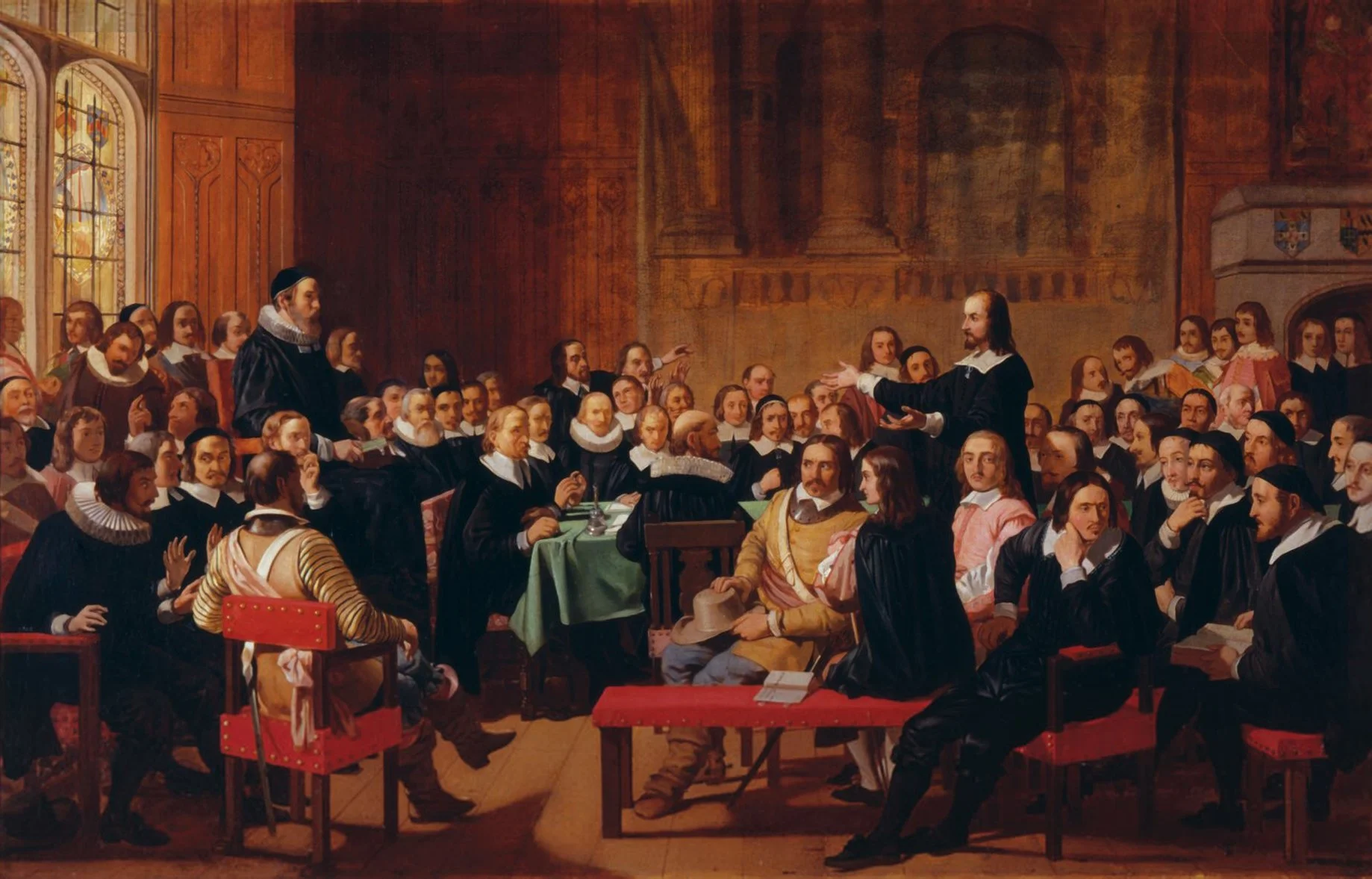
Assertion of Liberty of Conscience by the Independents of the Westminster Assembly of Divines—John Rogers Herbert (1810–1890)
Class Schedule | 6:30–8:30 pm
Schedule: Starting January 18 and alternating every other Sunday through May 10.
January 18, 2026
February 1, 2026
February 15, 2026
March 1, 2026
March 15, 2026
March 29, 2026
April 12, 2026
April 26, 2026
Course Description
This course offers a comprehensive survey of creeds and confessions in the history of the Christian church, emphasizing their role in clarifying and defining the biblical understanding of God's Word. Beginning with scriptural creeds and progressing through early church formulations to Reformation and post-Reformation documents, students will explore how these statements articulate positive affirmations of the faith while repudiating heresies and false teachings. The creeds do not interpret or define Scripture but rather represent the confessional understanding of its truth, serving as essential tools for doctrinal precision, unity, and the faithful transmission of the gospel across millennia.
Through lectures, readings, and discussions, participants will examine the historical contexts, theological developments, and practical implications of these creeds, highlighting their significance in opposing errors like Gnosticism, Arianism, and Arminianism. The course also addresses the development of catechisms and their role in instruction and succession of the faith, equipping students to think Biblically about God's nature, Christ's person and work, and the church's mission in today's context.
Textbook
The required textbooks for this course are:
Fairbairn, D., & Reeves, R. M. (2019). The Story of Creeds and Confessions: Tracing the Development of the Christian Faith. Baker Academic.
ISBN-13: 978-0801098161
Available for purchase at: Amazon, AbeBooks, Archive.orgRushdoony, R. J. (1998). The Foundations of Social Order: Studies in the Creeds and Councils of the Early Church. Chalcedon Foundation.
ISBN-13: 978-1879998124
This book will be provided to the students.
Course Requirements
Class Attendance and Participation. Due to the brevity of our class and the amount of material that we must cover, please make all possible arrangements to attend every class and fully participate in the discussions.
It is expected that you will have read all of the material with reasonable care and completed the homework, if assigned, before class.
A final 3–5 page paper will be completed before the end of the semester. An MLA Report template for download or use in Google Docs can be found here: https://www.scribbr.com/mla/formatting/
Creeds + Confessions Paper
Start thinking about this paper early on in the class! Draft a list of possible points of interest and think through them as we work through the various creeds and confessions in each class and throughout your reading. The sooner you narrow in on a few options for your theme, the better your paper will be. This paper will be presented briefly on the final class day.
To begin your paper, you will select a creed or confession (or a related theological development), and your paper will briefly attempt to assess it in terms of its purpose understood in light of Christ having appeared at the beginning when He created the world, appeared in the middle of history when He redeemed the world, and will return at the end for the final judgment. Emphasize how the creed clarifies the church's understanding of Scripture, opposes heresy, and contributes to the faithful succession of the gospel.
How to best structure the paper:
Introduction: State the thesis of the paper and preview the argument of the paper in the first two paragraphs. To be clear, the thesis of the paper is the conclusion to the theme you selected. Explain what methodology you will use to demonstrate your thesis.
Body of the paper: The purpose of the body of the paper is to prove your thesis. This is where you will trace the creed or confession from its historical origins to its enduring impact. Establish the connection to biblical truths, the opposition to false teachings, and the working out of doctrinal precision in the life of the church.
Conclusion: In the conclusion, restate your thesis and summarize the sections of your argument for this thesis. Here you get to make one final appeal in different language than utilized to this point in the paper.
A resource that further explains this can be found for free from Dr. John Frame here: https://www.proginosko.com/docs/frame_theol_paper.html.
Possible topics could include:
The Nicene Creed's Role in Defending Christ's Deity Against Arianism
The Chalcedonian Definition and Its Precision on Christ's Two Natures
The Heidelberg Catechism's Emphasis on Comfort in Christian Doctrine
Baptist Confessions and Their Development of Ecclesiology
The Canons of Dort as a Response to Arminian Challenges
The Apostles' Creed in Early Church Catechization